
Loading...
Serving Abilene, TX and surrounding areas(325) 283-1586
Abilene Insulation Company delivers retrofit insulation services to Haskell, TX, focusing on blown-in attic upgrades, dense-pack wall fills, and air sealing for Haskell County homes. Most properties here were built before Texas adopted its first energy code in 2001, and the gap between what those homes have and what they need is where we go to work. Every project is TDLR-documented, and we respond to all Haskell inquiries within one business day.
Matched to Haskell County's housing stock, building ages, and central Texas climate.
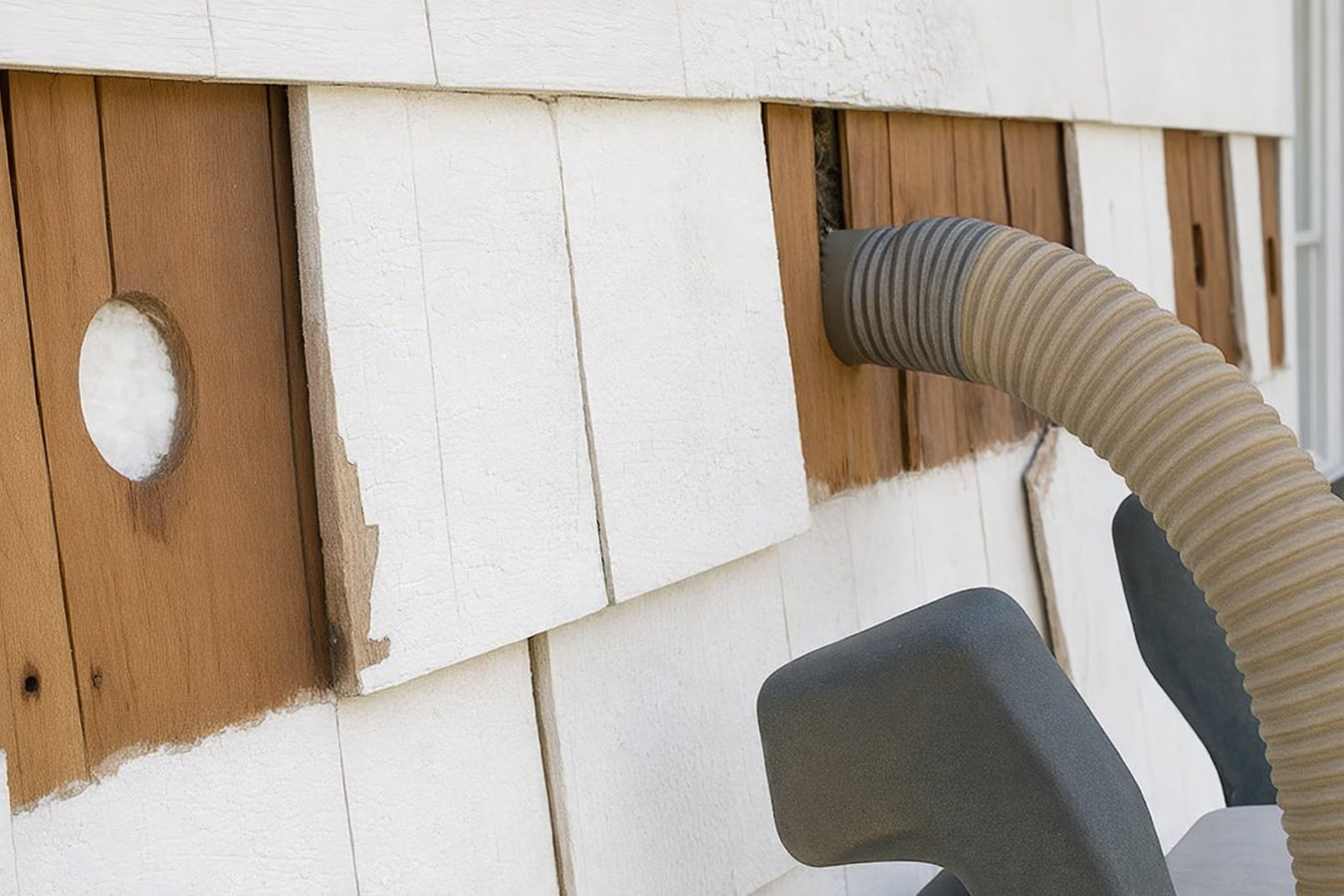
The overwhelming majority of Haskell's 1,396 housing units were built without any mandatory insulation standard. Texas did not adopt a statewide residential energy code until 2001, which means a Haskell home built in 1975 was constructed with whatever insulation — or none — the builder chose. Retrofit insulation closes that gap without opening walls or ceilings: blown-in cellulose covers attic floors in a single day, and dense-pack wall fills use small drilled access holes that are patched before the crew leaves. The result is a home that performs closer to modern standards without a renovation budget.
Blown-in cellulose or fiberglass is the workhouse of attic retrofit work in Haskell. It installs over existing material without disturbing ceilings, fills around irregular framing, and reaches the tight spots near eaves where batts leave gaps. For the many Haskell County homes with attic insulation at R-11 or less — a common finding in pre-code construction — a single blown-in top-off to R-38 or better delivers the biggest energy return of any single home improvement available.
Haskell's summers push well past 100°F across the cotton and peanut farming plains of Haskell County. Attic temperatures on peak days regularly hit 140 to 150°F, and the insulation separating that air mass from your living space is doing significant work. The IECC Climate Zone 3 minimum of R-38 at the attic floor is not a luxury target for homes in this climate — it is the threshold at which the thermal barrier actually performs its function through a central Texas summer.
Haskell sits on the open rolling plains of central Texas, and the persistent winds that cross that terrain push fine particulate dust through any gap in the building envelope. Those same gaps let conditioned air out and unconditioned air in, undermining whatever insulation sits above them. Sealing top-plate penetrations, plumbing chases, and recessed light cans before blown-in insulation goes down is what converts an adequate insulation job into a high-performance one.
Older Haskell homes on pier-and-beam foundations have uninsulated floor systems exposed above open crawl spaces. In a climate with Haskell County's temperature swings — 30 to 40 degree day-to-night differentials are common in spring and fall — an uninsulated floor transfers that thermal stress directly into the living space above it. Insulating below the floor joists and installing a vapor barrier on the ground reduces both floor-level discomfort and the moisture that migrates upward from soil into wood framing year-round.
Haskell is the county seat of Haskell County, a rural central Texas community of about 3,089 people whose economy has been shaped by cotton and peanut farming, oil production from the Lawson oilfield east of town, and the steady, quiet pace of a county seat that has operated continuously since 1885. The 2020 census counted 1,396 housing units in the city, with a 19.2% vacancy rate — a profile that reflects an aging housing stock, some deferred maintenance, and a significant population of long-term owner-occupants who have been in their homes for decades without a major renovation.
Nearly 20% of Haskell residents are 65 or older, which correlates strongly with long-term homeownership and properties that were purchased before modern energy codes existed. Homes built in Haskell in the 1950s, 1960s, and 1970s were constructed with no statewide insulation requirement — whatever was installed reflected the builder's judgment and the material costs of that era, not a performance standard. The result is a large share of the housing stock carrying attic insulation well below R-19 and wall cavities that are either empty or hold original batts that have compressed and shifted over 40 or 50 years of temperature cycling.
IECC Climate Zone 3 conditions define Haskell's thermal demands. Summer highs above 100°F are common across the surrounding farmland through July and August, while winter cold fronts push overnight lows into the teens and low 20s. Those temperature swings — sometimes 30 to 40 degrees within a single day during spring and fall — cause wood framing and original batt insulation to expand and contract repeatedly, displacing insulation from stud bays and compressing it below its rated performance over time.
Haskell's rural, fully unurbanized character means that energy costs arrive as larger shares of household budgets than in metro areas. There are no district heating systems, no walkable density efficiencies — just individual homes on the open plains, each managing its own heating and cooling load entirely. A well-executed retrofit insulation upgrade in Haskell pays back consistently because the baseline is low and the climate demands are high.
Haskell homes present a specific attic challenge we have run into repeatedly: low-pitch roof lines on frame construction from the 1960s, with tight clearance near the soffits and original blown-in fiberglass that has settled to 2 or 3 inches over decades of thermal cycling. The right approach is a pre-insulation air seal at the top plate, insulation baffles at the eaves to protect soffit ventilation, and then a full blown-in top-off to R-38 or better. Skipping the baffle step — which some crews do — leads to insulation blocking the soffit vents and creating moisture problems in the roof assembly. We do not skip it. For Haskell projects that require permits, we work through the City of Haskell building department on Avenue B, which handles permitting separately from Haskell County.
Getting to Haskell from our Abilene base means heading north on US-277, through Anson, and continuing into Haskell County — about 60 miles of relatively straight highway. The Haskell County Courthouse, an 1892 Classical Revival limestone building on the town square, is the reference point most Haskell residents use to orient visitors. The residential streets surrounding the courthouse square include some of the oldest housing in the city — single-story frame homes that are strong retrofit candidates. We also serve customers on the rural county roads east of town toward Stamford, where pier-and-beam farm homes on open acreage often have the most severe insulation deficits of any property type we encounter in this part of Texas.
Lake Stamford, about 12 miles southeast of Haskell, draws recreational traffic through the area from spring through fall. Many of the older fishing and weekend cabins near the lake are on the list of properties that most need insulation attention — frame construction, minimal original insulation, and heavy thermal cycling from seasonal-use patterns that leave them unoccupied through the coldest months.
Call or submit the estimate form. We respond to Haskell County inquiries within one business day. For calls during business hours, we typically respond the same day and can often schedule an assessment visit for the following week.
A crew member comes to the property, measures attic depth and condition, checks for obvious air infiltration points at the ceiling plane, and assesses wall cavity access if wall insulation is part of the scope. You get a written estimate with R-value targets and material recommendations. The visit is free with no obligation.
Price is confirmed in writing before any work begins. If a City of Haskell building permit is required, we handle the submission. Most Haskell County residential jobs are scheduled within the same week as the estimate visit, and we give you a specific installation date rather than a vague window.
After installation, a TDLR-required certificate is posted in the attic identifying the insulation type, manufacturer, installed depth, and R-value achieved. That documentation satisfies inspection requirements, supports federal tax credit claims, and gives you a clear record for any future home sale or insurance review.
We respond to Haskell and Haskell County inquiries within one business day. The on-site estimate is free and carries no obligation. After you reach out, we confirm a visit time, measure your attic and walls, and give you a written quote before any work begins.
(325) 283-1586Haskell is the county seat of Haskell County, a rural central Texas community of about 3,089 people named after Charles Ready Haskell, a soldier who died at the Goliad Massacre during the Texas Revolution. The townsite was originally called Willow Pond Springs — a watering stop for Native Americans, buffalo hunters, and early explorers moving through this part of the plains. County organization came in 1885, and the community grew quickly as cotton and grain farming expanded across the flat, productive land surrounding it. The discovery of the Lawson oilfield roughly six miles east of town before World War II added another economic layer, and by 1946 Haskell supported 114 businesses including cotton gins, creameries, and cottonseed oil mills.
Today Haskell is a tight-knit county seat where the 1892 Classical Revival courthouse on the town square remains in full active use, and where Haskell Consolidated ISD — centered on the high school football calendar that defines the social rhythm of most rural Texas towns — anchors community life. The city is perhaps best known nationally as the hometown of former Texas Governor Rick Perry, who served as the longest-tenured governor in state history and whose roots in Haskell County drew significant media attention during his 2012 presidential campaign. Lake Stamford, about 12 miles southeast of town, offers fishing, boating, and swimming for residents of Haskell County and the surrounding area.
The housing stock reflects a community that has grown slowly and stayed rural. Most residential buildings are single-story frame construction, many on slab or pier-and-beam foundations, built in the mid-twentieth century. The 2020 census recorded a median age of 39.9 years and a 19.5% senior population — both indicators of long-term homeownership and properties that have not had major renovations. With 0% of the population living in urban areas by census classification, Haskell is as rural as it gets in Texas, and that reality shapes how homeowners think about home maintenance and energy costs.
We serve the full range of Haskell County property types, from the older frame homes surrounding the courthouse square to rural ranch houses on county roads. Homeowners in nearby Stamford to the southeast and the communities along US-277 north of Abilene face similar housing ages and climate conditions, and we serve those areas on the same routes.
Spray foam seals air gaps and adds R-value in one application, making it one of the most effective options for attics, walls, and crawl spaces.
Learn moreProper attic insulation is the single biggest factor in keeping your home comfortable and your energy bills predictable year-round.
Learn moreBlown-in insulation reaches tight corners and irregular cavities that batts cannot, delivering consistent coverage across large areas quickly.
Learn moreWhole-home insulation assessments identify the weakest points in your building envelope and address them with the right materials.
Learn moreOld, compressed, or contaminated insulation reduces performance; removal clears the way for a fresh, properly installed system.
Learn moreInsulating the crawl space floor or walls keeps moisture and cold air from migrating into the living areas above.
Learn moreWall insulation reduces heat transfer through the building envelope and lowers the load on heating and cooling equipment.
Learn moreAir sealing closes the gaps, cracks, and penetrations where conditioned air escapes and outside air enters uncontrolled.
Learn moreBasement insulation stabilizes temperatures in the lowest level of the home and prevents cold floors from pulling heat out of the rooms above.
Learn moreClosed-cell foam provides the highest R-value per inch available and acts as both an air and vapor barrier in a single layer.
Learn moreOpen-cell foam is a cost-effective choice for interior walls and attics where a vapor-permeable, sound-dampening material is preferred.
Learn moreSealing the attic floor before adding insulation prevents stack-effect air movement and dramatically improves overall thermal performance.
Learn moreA vapor barrier installed on the crawl space ground stops ground moisture from rising into floor framing and living areas.
Learn moreVapor barrier installation protects wall assemblies and below-grade spaces from moisture accumulation that leads to mold and structural decay.
Learn moreRetrofit insulation adds thermal protection to existing walls and attics without requiring full demolition or major reconstruction.
Learn moreCommercial insulation solutions for warehouses, office buildings, and industrial facilities reduce operating costs and improve occupant comfort.
Learn moreServing these cities and communities.
Most Haskell County jobs are scheduled within the same week of the free on-site assessment — no vague timelines.